“Bean Seed” search results (1000)

Coffee and its products-terminology
The national standard of the people's Republic of China Coffee and its products Vocabulary GB/T 18007 1999 terms for coffee and its products this standard specifies the most commonly used terms for coffee and its products. This standard is applicable to the formulation and revision of relevant standards and documents, as well as the preparation and translation of professional manuals, teaching materials, books and periodicals. 2 Coffee nouns and definitions 2.1 General techniques
2015-08-14 Coffee and its products terms people's Republic of China national standards coffee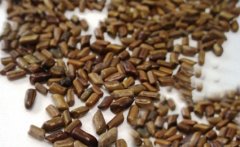
About the recent sale of fake coffee seeds on the Internet.
Recently, a student asked us that he had bought some coffee seeds on the Internet, showed us the pictures and asked if they were coffee seeds. It doesn't matter if I don't see it. I'm scared when I look at it. Where is the coffee seed? it is clearly a kind of Chinese herbal medicine called Cassia seed. Cassia seed is the dry mature seed of leguminous annual herb Cassia or Cassia. Cassia son is also called Cassia Ming, Yangming, Yangjiao and Ma.
2014-10-09 Coffee knowledge Coffee seed Coffee Encyclopedia
The cultivated varieties of Coffee Tree: small seed and large seed
3. Cultivated varieties (1) small seed species (2) large grain species Coffea belongs to Rubiaceae, Coffea belongs to perennial evergreen shrubs or small trees, there are about 90 species. At present, there are small seed species (Arabian species), medium grain species (Gaffra species) and large grain species (Liberian species) cultivated in Hainan. (1) small seed species: also known as Arabian species, native to Ethiopia, evergreen shrubs. The plant is small, 4cm high and 5m high
2015-10-07 Coffee cultivation variety small grain large grain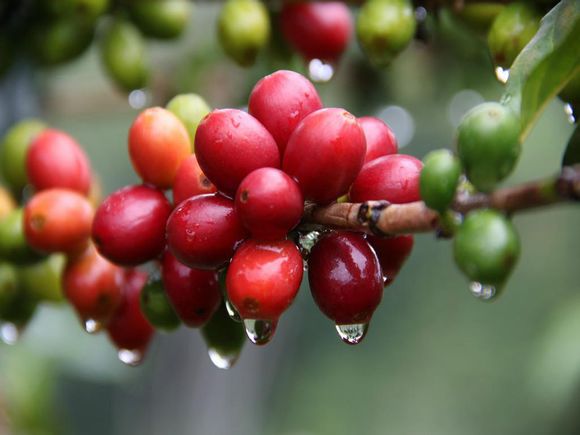
Coffee bean seed price how much coffee bean planting coffee bean price seed coffee raw bean sun plus snow
Coffee seeds cannot be grown directly with coffee fruits picked from coffee trees. Peeling coffee fruits is like planting peanuts. If you plant a peanut with a shell in the soil, it cannot sprout. You must plant peanuts. It is the same with medium coffee. If you have coffee fruit in your hand, you can first bask it in the sun and shake it until it is shaken inside.
2016-04-15 Coffee beans seeds price how much planting coffee raw beans sun Yega
Chinese Coffee Bean introduces Pu'er 's "Simao small seed Coffee"
Pu'er City is located between 22 degrees 02 to 24 degrees 50 minutes north latitude and 99 degrees 09 minutes to 102 degrees 19 minutes east longitude. Passing through the Tropic of Cancer, Pu'er City is a plateau climate zone with low latitude and humid monsoon climate in the south subtropics. It is in the same latitude as the world-famous coffee growing area Colombia, which is the golden zone of coffee cultivation. Cultivation of Simao small seed Coffee in Pu'er City
2014-10-17 Coffee knowledge Chinese coffee beans Pu'er coffee beans small grains of coffee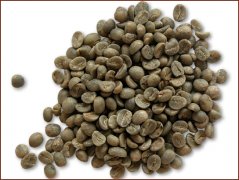
Photo of Yunnan small seed Coffee Raw Bean (Arabica)
Photo of Yunnan small seed Coffee Raw Bean (Arabica)
2014-05-16 Coffee beans coffee knowledge Yunnan coffee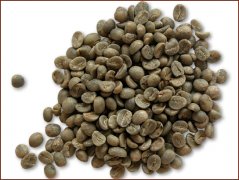
Chinese Fine Coffee beans recommend Yunnan small seed Coffee Raw Bean Picture (Arabica)
Photo of Yunnan small seed Coffee Raw Bean (Arabica) (this article is reprinted)
2015-10-14 China boutique coffee beans recommendation Yunnan small grains coffee raw beans pictures Ar
Variety characteristics of Yunnan small seed Coffee Bean introduction to the planting conditions of Yunnan Coffee producing area
Small seed coffee is native to the lower part of the Ethiopian rainforest in northern Africa. The temperature is relatively low, with an average annual temperature of 20 degrees. The origin of medium-grain coffee is near the equator. Therefore, small seed coffee has stronger cold tolerance and wider adaptability than medium grain coffee. Medium-grain coffee requires a slightly higher temperature. First, the importance of temperature
2021-11-17 Yunnan small grains coffee planting environment requirements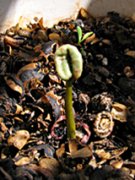
60 days after sowing, coffee seed beans
After 60 days of sowing, the germination period of coffee seed beans after initial radicle germination should be based on the principle of keeping the seedling pot moist. Ideally, in the temperature range of 19-26 ° C and moisture conditions, seeds need 55-60 days from sowing to emergence, with the highest emergence rate at 80 days. Kunming is in the temperature range of 6-25℃ during this period, so the seedling pot is intentionally placed on the sunny windowsill in the house and covered with plastic at night.
2015-10-07 coffee seeding process diva seed beans emergence
The whole process of planting and growth of coffee beans
Common questions about coffee bean cultivation: first, what are coffee kernels? How did you get the coffee seeds? Coffee seed, commonly known as coffee shell dried bean, is a kind of coffee seed without removing mesocarp and silver skin. Coffee seed is divided into Arabica Arabica seed and Robusta Robasta seed. The picture shows the commercial coffee raw bean available for consumption, and it is also the two major commercial plants on a large scale.
2015-04-24 Coffee beans growing the whole process about coffee beans planting common problems.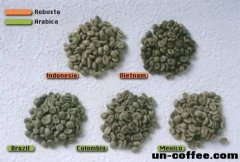
Coffee classroom: the difference between Arabica and Robusta coffee beans
The world's coffee beans are mainly divided into two categories: small seed coffee bean Arabica (Arabica) and medium seed coffee bean Robusta (Robusta). Small seed coffee beans grow in the temperate zone and climate of Haiba, with a rich and delicate taste, strong smell, high acidity and smooth texture, bringing strong aroma and smoothness to the coffee. Medium seed coffee bean is just like its English name Ro.
2014-07-23 Coffee lecture hall coffee bean classification coffee bean type coffee bean difference coffee encyclopedia
What's the difference between Arabica and Robusta?
The world's coffee beans are mainly divided into two categories: small seed coffee bean Arabica (Arabica) and medium seed coffee bean Robusta (Robusta). Small seed coffee beans grow in the temperate zone and climate of Haiba, with a rich and delicate taste, strong smell, high acidity and smooth texture, bringing strong aroma and smoothness to the coffee. Medium seed coffee bean is just like its English name Ro.
2015-11-02 Arabica Robusta what the difference the whole world coffee beans
The Life of two kinds of Coffee beans of Arabica Arabica and Robusta Robusta
Coffee beans in the world are mainly divided into two categories: small seed coffee bean Arabica (Arabica) and medium seed coffee bean Robusta (Robusta). Small seed coffee beans grow in a temperate climate of 600-2000 meters in Haiba, with rich and delicate taste, strong smell, high acidity and smooth texture, bringing strong aroma and smoothness to the coffee. Medium seed coffee bean is just like its English name Robusta.
2016-04-12 Arabica rabbi Robusta Robbs Booth two kinds coffee
Talking about Coffee beans
1. Summary: coffee is a perennial evergreen shrub or small tree of Rubiaceae. It is native to tropical Africa and has been cultivated for more than 2000 years. The Arabs began to grow coffee in 525 BC, and it was popular for Arabs to stir-fry coffee beans. They began to grow coffee beans on a large scale after the 15th century, and were widely distributed in the tropics and subtropics of Europe, Asia, Africa and Latin America after the 18th century.
2014-07-02 Coffee beans coffee bean history coffee bean uses
A brief discussion on the perennial evergreen shrubs of the genus Coffee
1. Summary: coffee is a perennial evergreen shrub or small tree of Rubiaceae. It is native to tropical Africa and has been cultivated for more than 2000 years. The Arabs began to grow coffee in 525 BC, and it was popular for Arabs to stir-fry coffee beans. They began to grow coffee beans on a large scale after the 15th century, and were widely distributed in the tropics and subtropics of Europe, Asia, Africa and Latin America after the 18th century.
2015-08-19 Talking about coffee beans coffee perennials evergreen shrubs overview grass more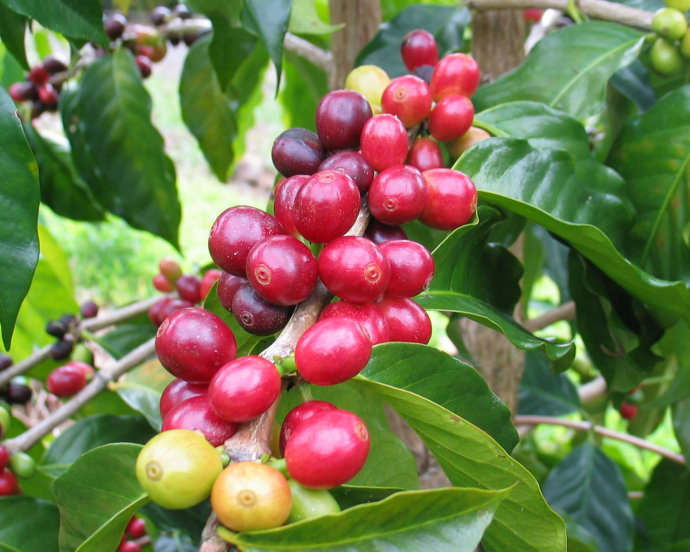
The process of Coffee Fruit from seed to growth to Post-harvest treatment Analysis of layered Anatomy of Coffee Bean
After the coffee flowers fade, they are replaced by small coffee fruits. The ripe coffee fruit is red and looks a bit like the familiar cherry, called coffee cherry. The freshman coffee fruit is green and turns red after ripening for about six months. After maturity, if it is not picked in time, it will slowly turn black. The color of mature coffee fruit is related to the variety, most coffee
2016-01-20 Coffee fruits seeds growth picking treatment process coffee beans stratification anatomy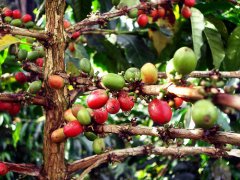
How to grow coffee berries and beans
Coffee fruit is a berry, also known as comb fruit. Oval, 9-14 mm long, young fruit green, red at maturity, purplish red. Each fruit generally has two seeds, but also one or three, showing a semi-oval, there is a longitudinal groove, called grooves. This is the past life of coffee beans, there are coffee branches, leaves, fruits, as well as dissected pulp, seeds, roasted coffee beans. What we see every day
2016-05-31 Coffee berries coffee beans how planting coffee fruit also known as combs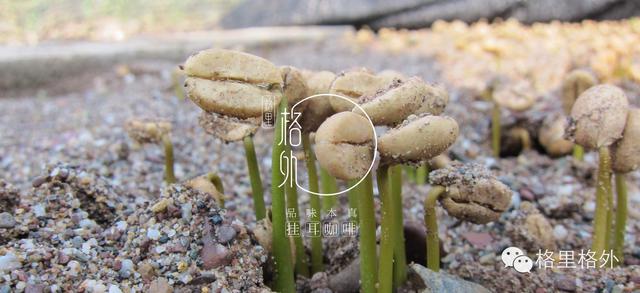
Coffee beans used to look like this. A diagram of the process of coffee beans from seed to treatment to roasting.
Illustrate the whole process of coffee from bud, seedling, flower, fruit to bean. The growth process of beans: seedlings, flowers, green fruits, red fruits. Anatomical picture of coffee bean fruit! According to the order, green fruit, green fruit anatomy red fruit, red fruit tissue, red fruit anatomy. Bean processing process 1: sunburn bean processing process 2: washing bean processing process 3: honey treatment source: Grieg outside
2016-01-13 Coffee beans originally like this seeds treatments methods roasting beans processes diagrams
Coffee fruit
The fruit is a berry, also known as comb fruit, oval, 9-14 mm long, young fruit green, red when ripe, purplish red.
2014-06-14 Coffee knowledge coffee fruit coffee encyclopedia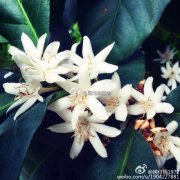
Robasta seed bean shape larger, obverse gradually round, convex abaxial, crack straight
Bean shape is larger, the front gradually round, the back was round convex, crack straight. Robasta coffee trees are native to Madagascar in central and western Africa and Indonesia in Asia, accounting for about 20% to 30% of the world's production. Robasta coffee tree is suitable for planting in lowlands below 500 meters above sea level, and is extremely adaptable to the environment, able to resist harsh weather and resist
2016-05-19 robas bas bean-shaped larger obverse tapering rounded faceted convex cracked